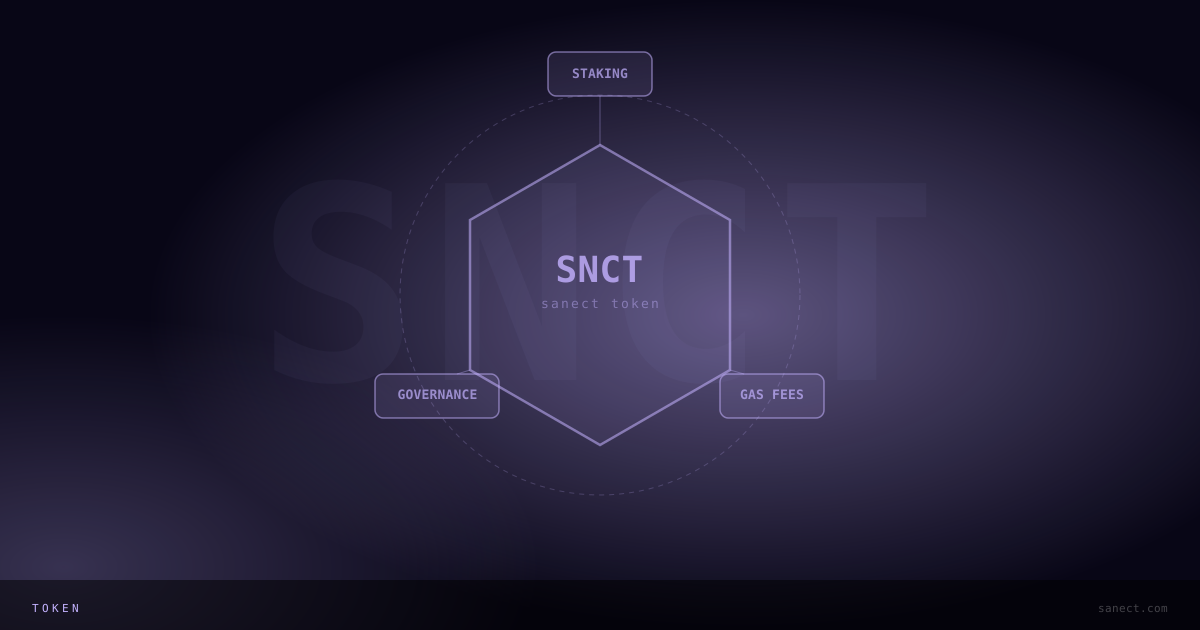
Three Utilities, One Token
SNCT is the native token of the Sanect chain (chain ID 7628). It has three distinct and non-overlapping uses: it secures the network through delegated staking, it governs protocol parameters through on-chain voting, and it pays for operations — including the computationally expensive business of generating and verifying zero-knowledge proofs for shielded transfers.
These three utilities are not cosmetic. Each one is load-bearing. Removing any of them would break the economic model that keeps the chain secure and responsive.
Base Unit: asnct
The smallest unit of SNCT is asnct — pronounced "atto-SNCT." One SNCT equals 1018 asnct, the same relationship as ETH to wei on Ethereum. When you interact with Sanect at the RPC or smart contract level, amounts are always expressed in asnct. When the UI shows "100 SNCT," the chain sees 100000000000000000000.
Total supply at genesis: 1,000,000,000 SNCT (1 billion). Inflation (7–20%, Cosmos Hub curve) adjusts circulating supply over time based on staking participation — fresh SNCT minted each block as the validator security budget.
The 1B genesis supply is split across ten transparent buckets: 30% Airdrop, 25% Treasury, 10% Community & Ecosystem, 10% LP Incentives, 10% Team, 5% Listings/Marketing/BD/Audit, 5% Validator Grants, 3% Foundation, 1% Advisors + Influencers, 1% Discretionary. No VC allocation. No anonymous strategic capital. Realistic Day 0 circulating supply is ~5M SNCT (genesis validator grants only). See the tokenomics page for the full breakdown and vesting schedules.
Staking: DPoS Security
Sanect uses Delegated Proof-of-Stake via the Cosmos SDK. Validators run nodes and produce blocks; delegators bond SNCT to validators they trust. The combined bonded stake of the active validator set is what makes the chain economically costly to attack.
Key mechanics:
- Block rewards are distributed through the distribution precompile at
0x0801 - Unbonding period is 21 days — unstaked SNCT is locked for 21 days before it becomes transferable
- Inflation target is 67% of total supply bonded. If bonded ratio is below 67%, inflation increases (up to 20%). If above, inflation decreases (toward 7%)
- Community tax is 2% of all inflation and fee rewards, directed to the community pool for governance-controlled spending
Staking from an EVM wallet is possible via the staking precompile, which exposes Cosmos-style delegation through a Solidity-compatible interface. You do not need to leave MetaMask to stake.
Governance: On-Chain Protocol Changes
SNCT holders can submit and vote on governance proposals. Proposals can change any module parameter — gas price floors, inflation bounds, community tax rate, new module activations — without requiring a hard fork.
The governance module is the Cosmos SDK standard: deposit period, voting period, quorum, threshold, veto. Proposals that reach quorum and pass threshold are automatically executed on-chain. There is no multisig, no team override, no timelock with an admin key. If a proposal passes, it executes.
On-chain governance is particularly relevant for privacy parameters — things like the shielded pool size limit or the minimum note value — which can be updated by token holders without a chain upgrade.
Gas: Paying for Operations
SNCT is the gas token for all transactions on Sanect. Standard EVM transactions (ERC-20 transfers, contract deployments, DEX swaps) pay gas in SNCT just as they would pay in ETH on Ethereum.
Shielded transfers are more expensive than standard transactions because they involve generating a zero-knowledge proof (UltraHonk via Noir) and verifying it on-chain. The verification step is a non-trivial computation that consumes more gas than a typical transfer. Gas price for this is set by the network's min-gas-price parameter, which governance can adjust.
The WERC20 Precompile
Native SNCT and ERC-20 SNCT are the same token through the WERC20 precompile at address 0xEeeeEeeeEeEeeEeEeEeeEEEeeeeEeeeeeeeEEeE. This means you can use SNCT in any EVM contract that expects an ERC-20 token without wrapping it first. The precompile handles the interface translation transparently — balanceOf, transfer, approve, transferFrom all work as expected.
Mainnet Is Live
Sanect mainnet launched on chain ID 7628 (Cosmos: sanect_7628-1). The 1B genesis supply is split across the ten allocation buckets described above. Gas is set at 1 gwei — essentially free for users (a 21k-gas transfer costs ~0.000021 SNCT) but still real enough to make spam structurally expensive. Gas pricing is governance-configurable going forward.
The locked tokenomics, vesting schedules, and airdrop phases are detailed on the tokenomics page. A testnet (chain ID 76287) remains available at rpc.testnet.sanect.com for developers.