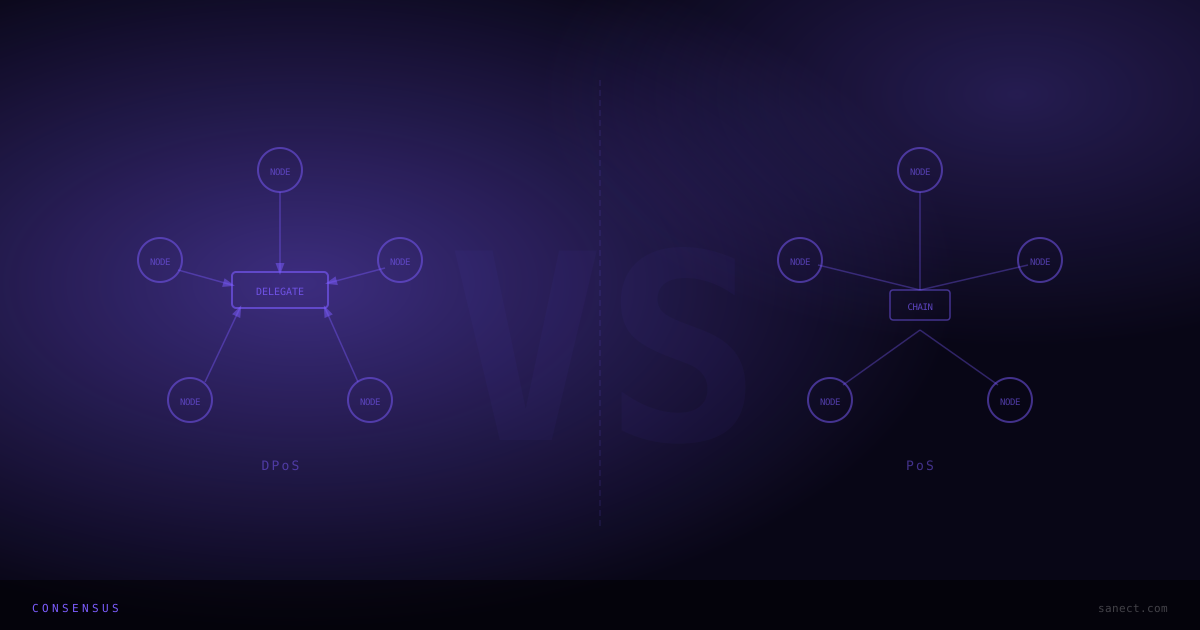
When people say "proof of stake," they often mean radically different systems. Ethereum's PoS has over 900,000 validators, each staking 32 ETH, with block proposals assigned probabilistically. Sanect's DPoS has 50 active validators, selected by total delegated stake, with BFT round-based consensus. The same three letters, very different designs.
Pure PoS Mechanics
In a pure proof-of-stake system like post-Merge Ethereum, any address meeting the minimum stake requirement can become a validator. Ethereum requires 32 ETH. Each validator independently runs software that proposes and attests to blocks. Block proposals are assigned pseudo-randomly, weighted by stake. The security model assumes that as long as fewer than 1/3 of total staked ETH is controlled by Byzantine actors, the chain remains safe.
The strength of this model is its openness: anyone meeting the minimum can participate. The challenge is scalability — with hundreds of thousands of validators, coordination is expensive. Ethereum manages this through committees (subsets of validators), attestation aggregation, and long finality periods (two epochs, roughly 13 minutes for full economic finality). The O(n) message complexity is managed but never eliminated.
DPoS Mechanics
Delegated Proof of Stake, as used in Cosmos SDK chains including Sanect, works differently. Anyone can register as a validator, but only the top N by total delegated stake form the active set that produces blocks. Other registered validators wait in a queue. Token holders delegate their stake to validators they trust — the validator earns commission on rewards generated by that delegated stake.
Active validators participate in BFT consensus (CometBFT in Sanect's case), where finality is achieved when 2/3 of the weighted validator set signs the precommit phase. This is single-slot finality — no waiting for attestation periods or epoch boundaries. A block is final the moment 2/3 precommit, which happens within the ~400ms block time.
Why Validator Count Matters for Block Time
CometBFT's consensus requires O(n²) message complexity in the worst case. Every validator must communicate with every other validator to achieve the 2/3 signature threshold. At 50 validators, a round involves up to 2,500 message exchanges. At 150 validators, that grows to 22,500 — nine times the load at the same network conditions.
The math behind Sanect's 50-validator ceiling is straightforward: at the target topology (validators distributed across Singapore, Mumbai, Frankfurt, US East, and other regions), the round-trip time between the slowest pair in the 2/3 majority is approximately 220ms. Combined with execution and signature verification overhead, the minimum realistic block time is ~400ms. Adding more validators lengthens the tail — the longest message path grows, and so does the consensus timeout needed to accommodate it.
This is not a Sanect-specific limitation. Cosmos Hub, Osmosis, and other production CometBFT chains all use active sets in the 150-200 range as their ceiling, with 100 being a common practical limit for competitive block times.
Capital Efficiency: Delegators Earn Without Hardware
DPoS creates a capital efficiency advantage that pure PoS systems with high minimums do not have. In Ethereum's system, you either stake 32 ETH and run a validator node, or you use a liquid staking protocol (Lido, Rocket Pool) which introduces counterparty risk and protocol risk. There is no native "delegate to a trusted operator" path in the base protocol.
In Sanect's DPoS, any SNCT holder can delegate to any registered validator directly at the protocol level — no liquid staking derivative required. Delegators earn inflation rewards proportional to their stake, minus the validator's commission. They do not need to run any hardware. Their tokens remain in their custody (staked at the protocol level, not transferred to the validator).
This means the total staking participation rate can be high — all SNCT holders can contribute to security proportionally — while the operational complexity stays concentrated in the active validator set.
Centralization Risks
The honest critique of DPoS is centralization risk. A fixed active set creates a concentration of power in 50 operators. If these operators coordinate — or are coerced — they could theoretically censor transactions or halt the chain. This is a real risk, not a theoretical one: several DPoS chains have experienced periods of cartel behavior among their validator sets.
Pure PoS with a large validator set distributes this risk more broadly. 900,000 Ethereum validators are genuinely harder to coordinate for nefarious purposes than 50 Sanect validators.
The mitigation in Sanect's design is geographic and jurisdictional distribution (Variant A topology: no single country holds 2/3 of stake), unlimited registration (the waiting queue means economic upward pressure on honest validators from those waiting to replace them), and on-chain governance (token holders can vote to change parameters). These are meaningful mitigations, not perfect solutions.
Why Sanect Chose DPoS With Unlimited Registrations
The design objective was to find the best combination of: fast block time (sub-500ms), accessible participation (anyone can register), and meaningful decentralization signal (not just a handful of operators). Pure PoS with a large active set fails on block time. Pure PoS with a small active set fails on decentralization. DPoS with unlimited registrations threads the needle.
The unlimited registration policy means the registered validator count can grow to thousands over time, even though only 50 are active at any point. Delegators can shift stake between validators. The waiting queue creates competitive pressure. This is structurally different from a closed committee of 50 fixed seats — anyone can enter, anyone can rise, and poor performance or bad behavior leads to delegation leaving for better operators.
The 50-Validator Active Set: The Math
Why 50 specifically? At 50 validators with CometBFT, the expected round includes up to 2,500 message exchanges. At 400ms block time, the network handles roughly 6,250 message exchanges per second in steady state — well within the capacity of modern networking. Increasing to 100 validators doubles the message load and pushes block time toward 600-800ms under realistic network conditions. At 200 validators, block time exceeds one second.
The path to meaningfully larger active sets without sacrificing block time runs through BLS signature aggregation — reducing O(n²) communication to O(n) by aggregating signatures. This is future protocol work. Sanect v1 ships with the honest number: 50 active validators, ~400ms blocks, unlimited registration queue for decentralization at the economic layer.